Outside the Frame
“Resemblances are the shadows of differences. Different people see different similarities and similar differences.”
― Vladimir Nabokov, Pale Fire
I’ve worked with many visually-minded people over the years; the ones with talent do things with color, shape, form, and space that I frankly am not sophisticated enough to understand fully but that I appreciate immensely. I’ve studied a lot of graphs, charts, and visualizations; those done well illuminate notions that raw data obfuscates in a way that is sometimes breathtaking. However, some things are too complex, too large, or too multi-faceted for the human brain to sort out by merely looking. Try as you might to reduce it to a simple graph in a quarterly report or a combination of brush strokes on a canvas, visual representation alone falls short in many ways when it comes to representing more nuanced ideas often because ideas exceed the few dimensions in which we try to represent them.
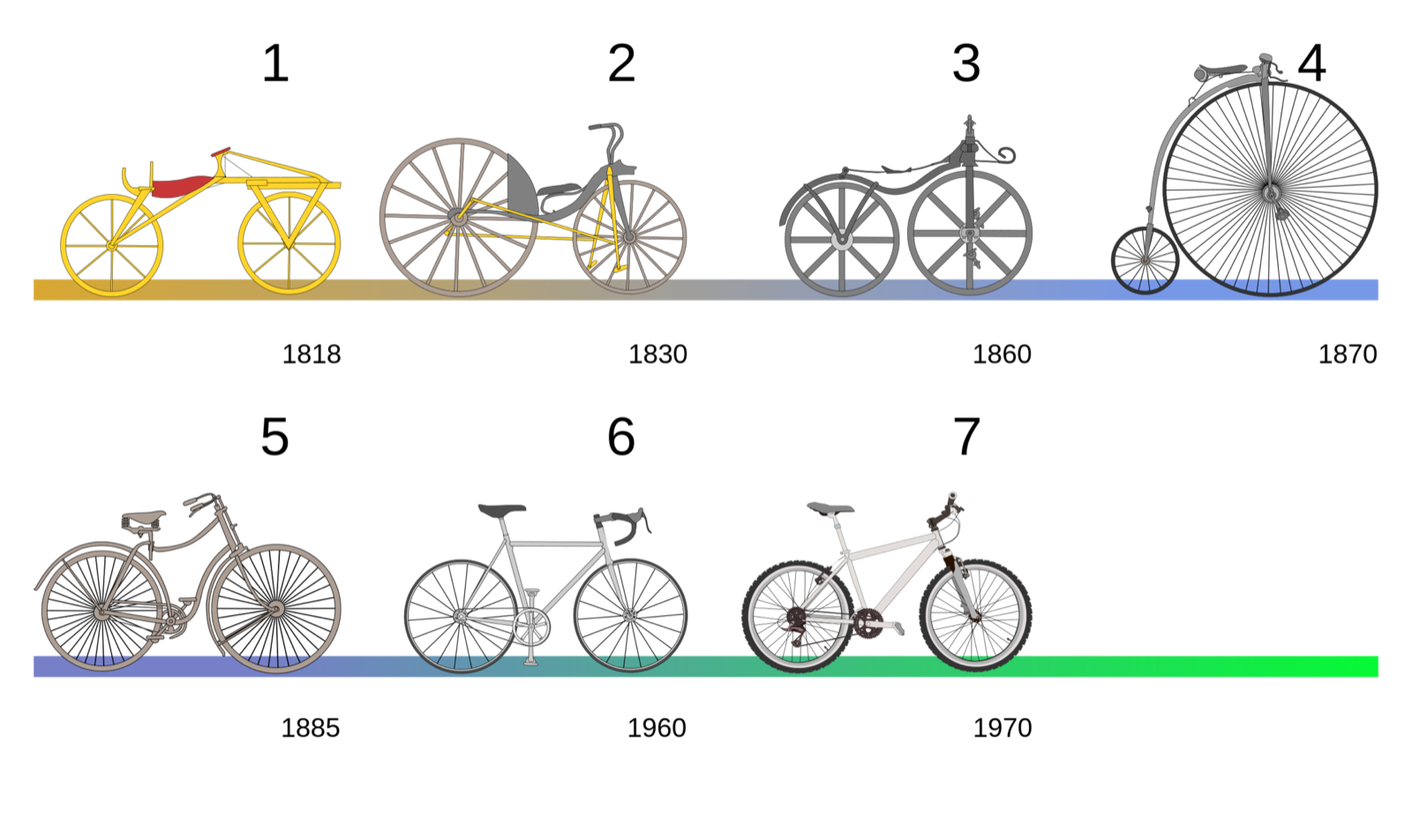
The image above represents the stages in the evolution of the bicycle. Nearly everything about it can be represented visually. We see the slow evolution of a canted head tube, the formation of the modern seat, and the addition of a chain. Yet, the entirety of its development can’t be found in this one image; like most things in life, the story behind the image is bigger than the edges of the frame. The full story likely encapsulates innovations in materials, as well as invention and collaboration from history. It probably speaks to the broader themes of function and form, efficiency, and even human progress. I say probably because I don’t know the full story; I’m not a bicycle expert.
The interesting thing, however, is that if an image can’t fully represent something as simple as the story of bicycles, what chance do we have to represent something as complex as language, the economy, or the internet? And yet, how often have you seen web 1-2-3 charts reductively attempting to distill the evolution of a hyper-massive and multi-layered network of machines spanning the globe into a single upward-trending line? To say nothing of accuracy, the temerity of boiling away all nuance, complexity, and thought to reduce any topic to a line slightly boggles my mind. Simplicity bias tends to drive us toward simple representations, but reality is nearly always more nuanced and complex than what can be expressed in a simple diagram. While we often find comfort in the tiny slice of truth that comes with reducing a subject to what we can draw, the context, the narrative, the bias, and the nuance usually lie somewhere outside the axes.

Of course, this isn’t to say visual thinking, visualization, or visual mediums aren’t valuable. They’re incredibly valuable, but this is both the beauty and the curse of the visual medium: It hides the truth in plain sight. There is a lot that a picture can say, but what it doesn’t say is often even more important. The same lines that draw our eyes toward the point of focus can draw attention away from what isn’t depicted. Great artists can use this to great effect to send our minds spiraling down corridors of question after question simply by subtly calling attention to what’s proverbially left “out of frame.” What is the source of the figure’s terror in Munch’s The Scream, and what does that scrap of paper say in Sherman’s Untitled #96, after all? What is often most intriguing about an image is not what’s shown but what isn’t; in other words, what is left to our interpretation. We tend to fill in the gaps in different ways, and as Nabokov reminds us: we tend to see similar differences but different similarities.
Every image carries a certain level of simplification, bias, and omission. As viewers, it’s our job to look beyond the edges of the frame. The world is often bigger and more complex than we can see, and what’s left to our interpretation isn’t always spelled out for us. The understanding of complex ideas and subjects requires something larger than visual representation. We need perspective, experience, familiarity with the subject matter, context, narrative, and nuance. Without these things, what’s omitted is too easily missed, and we lose deeper understanding and implications; we operate on incomplete and simplistic interpretations of categorically complex ideas and phenomena. We focus on the obvious rather than the nuanced; we see the shadows rather than what casts them.